
Recovery
PROJECT SHOULDER
Strength, Control & Pain-Free Pressing
The Problem With Traditional Shoulder Fixes
YOU KEEP TRAINING AROUND SHOULDER PAIN… NOT SOLVING IT
You've tried "taking a week off" — but as soon as you're back under the bar, that dull ache returns. The issue isn't your dedication — it's your approach.
THE PROBLEM
TRADITIONAL SHOULDER FIXES DON'T WORK LONG-TERM.
Foam rolling and banded warm-ups only help for a few minutes. You've done "rotator cuff" exercises before, but never felt stronger afterward. You focus on big lifts — but ignore the smaller stabilizers that actually protect your shoulders.
THE SOLUTION
TARGET THE SCAPULAR STABILIZERS THAT CREATE LASTING STRENGTH.
Stop chasing temporary relief. Build a foundation of true shoulder stability by strengthening the small, often-ignored muscles that control your shoulder blade and protect your joint during every movement.
The Real Problem
YOU'RE STRENGTHENING THE WRONG MUSCLES
You focus on the big prime movers — deltoids, pecs, and lats — but ignore the smaller scapular stabilizers that actually protect your shoulders.
Trapezius (Lower)
Scapular Depression & Retraction
Why It Matters
The lower trapezius pulls your shoulder blades down and together, creating a stable base for overhead movements. When weak, your shoulders "shrug up" during pressing, causing impingement.
- Depresses the scapula
- Assists upward rotation
- Prevents shoulder hiking
Add image
Serratus Anterior
The "Boxer's Muscle"
Why It Matters
The serratus anterior wraps around your ribcage and anchors your shoulder blade. It's essential for protraction and upward rotation—key for any pushing or reaching movement.
- Protracts the scapula
- Prevents scapular winging
- Essential for punching & pushing
Add image
Rhomboids
Scapular Retraction
Why It Matters
The rhomboids sit between your spine and shoulder blades, pulling them together. They counteract the forward pull of tight pecs and help maintain proper posture during lifts.
- Retracts the scapula
- Elevates and rotates scapula
- Counteracts forward shoulder posture
Add image
Levator Scapulae
Scapular Elevation
Why It Matters
Running from your neck to your shoulder blade, the levator scapulae often becomes tight and overworked. Proper training helps balance it with the lower traps for optimal scapular control.
- Elevates the scapula
- Assists downward rotation
- Often tight from desk work
Add image
Rotator Cuff
The SITS Muscles
Why It Matters
Four muscles—Supraspinatus, Infraspinatus, Teres Minor, and Subscapularis—that wrap around your shoulder joint. They center the ball in the socket during every arm movement.
- Stabilizes the glenohumeral joint
- Controls rotation of the arm
- Most commonly injured shoulder muscles
Add image
Deep Stabilizers
Core-Shoulder Connection
Why It Matters
Your shoulder doesn't work in isolation. Deep core muscles, thoracic spine mobility, and the muscles connecting your shoulder blade to your ribcage all contribute to stable, pain-free pressing.
- Creates a stable foundation
- Transfers force from ground up
- Integrates shoulder with core
Add image
The Real Problem
YOU'RE STRENGTHENING THE WRONG MUSCLES
You focus on the big prime movers — deltoids, pecs, and lats — but ignore the smaller scapular stabilizers that actually protect your shoulders.
Trapezius (Lower)
Scapular Depression & Retraction
Why It Matters
The lower trapezius pulls your shoulder blades down and together, creating a stable base for overhead movements. When weak, your shoulders "shrug up" during pressing, causing impingement.
- Depresses the scapula
- Assists upward rotation
- Prevents shoulder hiking
Add image
Serratus Anterior
The "Boxer's Muscle"
Why It Matters
The serratus anterior wraps around your ribcage and anchors your shoulder blade. It's essential for protraction and upward rotation—key for any pushing or reaching movement.
- Protracts the scapula
- Prevents scapular winging
- Essential for punching & pushing
Add image
Rhomboids
Scapular Retraction
Why It Matters
The rhomboids sit between your spine and shoulder blades, pulling them together. They counteract the forward pull of tight pecs and help maintain proper posture during lifts.
- Retracts the scapula
- Elevates and rotates scapula
- Counteracts forward shoulder posture
Add image
Levator Scapulae
Scapular Elevation
Why It Matters
Running from your neck to your shoulder blade, the levator scapulae often becomes tight and overworked. Proper training helps balance it with the lower traps for optimal scapular control.
- Elevates the scapula
- Assists downward rotation
- Often tight from desk work
Add image
Rotator Cuff
The SITS Muscles
Why It Matters
Four muscles—Supraspinatus, Infraspinatus, Teres Minor, and Subscapularis—that wrap around your shoulder joint. They center the ball in the socket during every arm movement.
- Stabilizes the glenohumeral joint
- Controls rotation of the arm
- Most commonly injured shoulder muscles
Add image
Deep Stabilizers
Core-Shoulder Connection
Why It Matters
Your shoulder doesn't work in isolation. Deep core muscles, thoracic spine mobility, and the muscles connecting your shoulder blade to your ribcage all contribute to stable, pain-free pressing.
- Creates a stable foundation
- Transfers force from ground up
- Integrates shoulder with core
Add image
You Keep Training Around
Shoulder Pain… Not Solving It
- You’ve tried “taking a week off” — but as soon as you’re back under the bar, that dull ache returns.
- Transition line: The issue isn’t your dedication — it’s your approach.
Traditional Shoulder Fixes
Don’t Work Long-Term
- Foam rolling and banded warm-ups only help for a few minutes.
- You’ve done “rotator cuff” exercises before, but never felt stronger afterward.
- You focus on big lifts — but ignore the smaller stabilizers that actually protect your shoulders.
Sound Familiar?
You keep "training around" your shoulder pain instead of fixing it
That dull ache returns the moment you're back under the bar.
You've tried band work, rolling, and rest… but nothing sticks
Foam rolling and banded warm-ups only help for a few minutes.
You hesitate before every overhead press
Waiting for that familiar twinge, wondering if today's the day it gets worse.
You're trapped in the cycle: Pain → Rest → Repeat
Taking a week off never actually solves the underlying problem.
You've done "rotator cuff" exercises but never felt stronger
Generic exercises without progression don't build real stability.
You're tired of modifying every workout
Always avoiding certain movements, never training at full capacity.
Tired of Shoulder Pain Holding You Back?
- Anyone with on/off shoulder pain who still trains (but not debilitating to the point overhead pressing is taken out. Reach out to online PT if you cannot overhead press as this is a red flag and will require advanced intervention)
- Lifters, athletes, or everyday movers who want bulletproof shoulders
- Someone tired of modifying workouts to protect pain
- Those looking to restore full overhead mobility and stability pain free
- People seeking to prevent future injuries

3-4 days/week, 3 phases
(each lasting 4 weeks)
- Flexibility, Mobility & Activation
- Shoulder Strength Workout
- Stabilization Rehab Workout
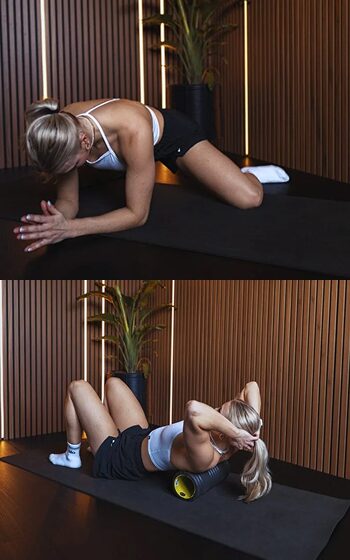
- Optional Shoulder Release @ Home
Why your traditional approach to
shoulder pain doesn’t work…?
Youre focusing on the wrong things!
Focusing on growing the BIG muscles and forgetting about the small stabilizing muscles of the shoulders like the rotator cuff, lower traps and serratus anterior
Phase-Based
Shoulder Pain Training
PHASE 1
Mobility & Scapular Activation
(week 1-4)
Goal: Open up the shoulders, re-educate functional patterns and regain scapular control Focus: Restore scapular stability and dynamic control
Focus: Restore scapular stability and dynamic control
- Day 1: Flexibility, Mobility & Activation
- Day 2: Scapular & Rotator Cuff Stabilization
- Day 3: Shoulder Strength Workout
- Day 4: Optional Shoulder Release @ home
PHASE 1
Strength &
Stability
(week 5-8)
Goal: Build load tolerance and controlled strength across planes
Focus: RReinforce scapular and rotator cuff stability under load
- Day 1: End Range Mobility & Activation
- Day 2: Stabilization Rehab
- Day 3: Shoulder Strength Workout
- Day 4: Optional Shoulder Release @ home
PHASE 1
Power &
Endurance
(week 9-12)
Goal: Develop maximum control and fatigue resistance
Focus: Combine strength, endurance, power, and shoulder stability
- Day 1: Advanced Mobility & Activation
- Day 2: Shoulder Endurance
- Day 3: Shoulder Strength & Power
- Day 4: Optional Shoulder Release @ home
FAQ
Yes, you will have lifetime access to any programs purchased! You can start, stop, pause, or reset programs at any time to fit your schedule and needs.
Yes, you will have lifetime access to any programs purchased! You can start, stop, pause, or reset programs at any time to fit your schedule and needs.
Yes, you will have lifetime access to the program! You can start, stop, pause, or reset the program at any time to fit your schedule and needs. Additionally, you’ll receive a PDF version of the program for easy referenc
- Our workouts and rehab sessions are delivered through the Revitalize Recovery app, available for download on both Android and Apple devices. The program is carefully structured with a clear daily schedule, including designated workout and rest days. Each workout is accompanied by high-quality 4K videos, offering step-by-step instructions for every movement, along with detailed information on sets, reps, and rest intervals. For those who prefer a more traditional approach, we also provide a PDF version of the program, so you can follow along offline or print it out at your convenience.
Yes, every exercise has a video with step-by-step instructions for each movement, ensuring you understand how to perform the exercises safely and effectively.
Every program is a one-time fee for lifetime access to perform in our Revitalize Recovery App. PDFs provided of the program must be downloaded separately from the resources tab of your purchased program.
Each program includes a list of required equipment, though most programs can be performed with just resistance bands, dumbbells, and a box or bench.
TESTIMONIALS
Real-Life Success and Transformations


Running into Jenny was nothing less than a stroke of divine intervention! After a year of dealing with a gym injury (torn labrum), it was time to have the right professional rehab it. Jenny’s knowledge, drive and expertise were more than I could have ever imagined! In just a short time, I was virtually pain free, stronger, and more confident in the gym. She’s got a knack for finding problems and solving them. Her training skills paired with her credentials make her the unicorn we’ve all been looking for. Jenny is personable, talented and a force of nature. I highly recommend her to anyone looking to add an unparalleled advantage to their training.

A string of unexpected injuries lead me to Dr. Jenny Brennecke. Little did I understand at the moment the tremendous impact that she would have in my life. Through Dr. Jenny’s guidance I was able to successfully rehab acute hamstring and shoulder injuries. Furthermore, through her detailed assessments she uncovered long standing chronic injuries that were severely effecting my athletic performance. Dr. Jenny has a very granular eye for detail, kind, empathetic, intelligent & authentic. Her imprint on me has been priceless and I am forever grateful.

I suffered from back pain, shoulder pain, and ankle pain due to my age and years of inactivity. Going back to the gym to start getting in shape only aggravated the issue. I went to see Dr. Jenny Brennecke to see if she could help. I have to say that she is a miracle worker. She was able to diagnose my situation and determine the best correct course of action for me to alleviate my pain. This consisted of a combination of physical therapy and home stretching exercises. While I required several sessions with her initially, I was able to gradually scale back to occasional as needed visits. I still do my home stretching exercises that Jenny prescribed, but am now pain free and much more mobile. Although I’m an older man in age, I now feel like a young man in mobility and spirit. I can’t thank Jenny enough for the help she has given to me. I would recommend her to anyone in need of physical therapy and/or mobility recovery.

Early Bird Discount — Save $15
STOP TRAINING AROUND YOUR SHOULDER PAIN
The 3-Phase System to rebuild your rotator cuff, restore scapular control, and unlock pain-free pressing in just 12 weeks.
Start Your Reset12
Weeks
3-4
Days/Week
3
Progressive Phases
Early Bird
SHOULDER RESET
12-Week Transformation Program
$75 $60
Early bird pricing • Limited time
- 3 Progressive Phases
- 4 Built-in Assessments
- Detailed Video Instruction
- Mobility Assessment Guide
SOUND FAMILIAR?
THE CYCLE YOU CAN'T ESCAPE
You keep "training around" your shoulder pain instead of fixing it
That dull ache returns the moment you're back under the bar.
You've tried band work, rolling, and rest… but nothing sticks
Foam rolling and banded warm-ups only help for a few minutes.
You hesitate before every overhead press
Waiting for that familiar twinge, wondering if today's the day it gets worse.
You're trapped in the cycle: Pain → Rest → Repeat
Taking a week off never actually solves the underlying problem.
You've done "rotator cuff" exercises but never felt stronger
Generic exercises without progression don't build real stability.
You're tired of modifying every workout
Always avoiding certain movements, never training at full capacity.
THE REAL PROBLEM
YOU'RE STRENGTHENING THE WRONG MUSCLES
You focus on the big prime movers — deltoids, pecs, and lats — but ignore the smaller stabilizers that actually protect your shoulders.
Your scapular stabilizers are the foundation. Without them, every overhead movement is built on an unstable base.
- Trapezius (Lower)
- Serratus Anterior
- Rhomboids
- Levator Scapulae
- Rotator Cuff
- Deep Stabilizers
Anatomy diagram
placeholder
THE SYSTEM
3 PHASES TO BULLETPROOF SHOULDERS
Progressive programming that takes you from mobility restoration to powerful, pain-free pressing.
01 Phase 1
MOBILITY & SCAPULAR ACTIVATION
Weeks 1-4
Goal: Open up the shoulders, re-educate functional patterns, and regain scapular control.
- 1 Flexibility, Mobility & Activation
- 2 Scapular & Rotator Cuff Stabilization
- 3 Shoulder Strength Workout
- 4 Optional Shoulder Release @ Home
02 Phase 2
STRENGTH & STABILITY
Weeks 5-8
Goal: Build load tolerance and controlled strength across all planes of movement.
- 1 End Range Mobility & Activation
- 2 Stabilization Rehab
- 3 Shoulder Strength Workout
- 4 Optional Shoulder Release @ Home
03 Phase 3
POWER & ENDURANCE
Weeks 9-12
Goal: Develop maximum control and fatigue resistance for lasting results.
- 1 Advanced Mobility & Activation
- 2 Shoulder Endurance
- 3 Shoulder Strength & Power
- 4 Optional Shoulder Release @ Home
WHO IT'S FOR
IS THIS PROGRAM RIGHT FOR YOU?
-
On/off shoulder pain that won't quit
You can still train, but that nagging discomfort never fully disappears.
-
Lifters & athletes who want bulletproof shoulders
Ready to prevent future injuries before they sideline you.
-
Anyone seeking full overhead mobility
You want to restore stability and move pain-free overhead.
-
Tired of modifying every workout
You want to train without constantly protecting your shoulder.
Important Note
This program is designed for on/off shoulder pain — not debilitating pain that completely prevents overhead pressing. If you cannot overhead press at all, this is a red flag that requires advanced intervention. Please reach out for online physical therapy recommendations before starting.
WHAT'S INCLUDED
EVERYTHING YOU NEED TO SUCCEED
Full Video Library
Every exercise demonstrated with detailed technique cues and coaching points.
4 Progress Assessments
Built-in checkpoints at Day 0, Week 4, Week 8, and program end to track your gains.
Mobility Assessment Guide
Learn exactly how to assess your own shoulder mobility and track improvements.
Progressive Programming
Structured progression from mobility to power—no guesswork required.
EQUIPMENT
WHAT YOU'LL NEED
Gym Equipment
- Dumbbells
- Kettlebells
- Barbells
- Cable Machine
- Long Resistance Bands
- Loop Resistance Bands
Recovery Equipment
- Foam Roller
- Lacrosse Ball
REAL RESULTS
SUCCESS STORIES
Right off the bat, the beginning of the session I felt instant relief on my shoulder/back! She did some deep tissue massage / scapular release, we went over a variety of stretches + strengthening movements. Definitely looking forward to the next session!
B
Belen O.
★★★★★
After a year of dealing with a gym injury (torn labrum), it was time to have the right professional rehab it. In just a short time, I was virtually pain free, stronger, and more confident in the gym. She's got a knack for finding problems and solving them.
R
Rachel F.
★★★★★
READY TO START?
Start Your Shoulder Reset
BUILD THE FOUNDATION YOUR SHOULDERS DESERVE
You don't need to stop training. You just need the right approach.
Early Bird
$75 $60
Start Your Shoulder Reset
12 weeks • 3-4 days/week • 3 progressive phases